
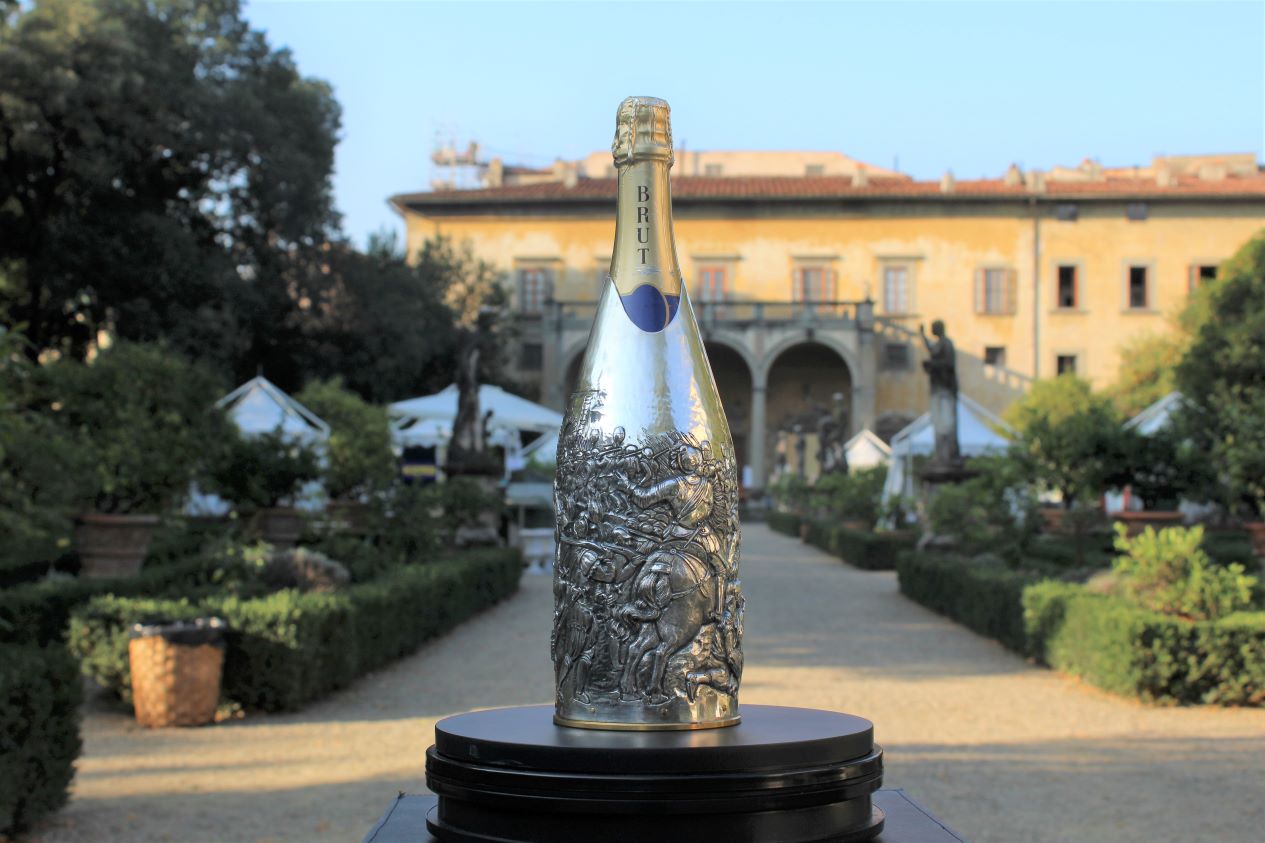
There are hands that don’t just create—they tell stories. Giuliano Foglia, a master chisel artist from Florence, is one of those rare figures capable of turning metal into art, following the time-honored gestures passed down through generations in his family’s historic workshop in the heart of San Frediano.
In this exclusive interview, Foglia reflects with clarity and passion on his long career: from his early days—initially taken for granted but later embraced with enthusiasm—to his mastery of the intricate “caccia in fuori” technique, and his collaboration with K-OVER, which gave life to extraordinary works like the “Fantasy” bottle cover.
It’s a journey into the value of time, patience, and detail. An ode to true craftsmanship, to the beauty born of dedication, and to the hope that—even in a fast-paced world—there will always be those who recognize the worth of things made with love.
1. You grew up in a family of artisans in the heart of San Frediano. What do you remember from your early days in the workshop, and what did it mean to learn this trade alongside your father and grandfather?
Working in the family workshop was seen almost as a duty—back then, there weren’t many alternatives. But I consider myself very lucky because I became passionate about the work right from the start. The environment was pleasant, and there was harmony not only in our workshop but throughout the neighborhood. The district was our home—we debated, sometimes argued, but there was strong solidarity among artisans, and we helped each other when needed. Learning came easily; we learned by watching, making mistakes, and trying again. As a boy, I didn’t realize how valuable it was to observe my father and grandfather at work, or how lucky I was to have such talented mentors. Today, I’m very grateful to them, and incredibly proud that my son Lorenzo, despite having a degree, chose to carry on the family tradition.
2. You started working in the 1960s. How has the world of craftsmanship changed since then?
The world of craftsmanship has undergone a true upheaval. We used to create commissioned pieces for museums, noble houses, and private clients who genuinely appreciated our work and understood the time and dedication needed. Our work was truly valued. Today, many people focus only on price—they want it low—and very few understand how demanding this work is when done entirely by hand. Tastes have also changed dramatically. Heavy silver pieces are no longer understood or desired by young people furnishing their homes.
3. One of your specialties is the “caccia in fuori” technique. Can you explain what it is and what makes it so fascinating?
Thank you for the opportunity to talk about this little-known technique, which represents the highest level of commitment for chisel artists like us. The “caccia in fuori” involves anchoring a lever to a metal arm inserted into a round or cylindrical shape, like our covers, allowing for internal chiseling. Taking the example of a champagne bottle cover, we receive it already in cylindrical form. The design is created from the inside using a chisel operated with a lever, pushing out the desired shapes and volumes. The artisan can’t see or reach inside the cover, so it’s all done in the dark, slowly and carefully—because small mistakes can be corrected, but a big one ruins everything. Creating pieces like the Fantasy cover using this technique took several months.
4. You’re known for crafting your own tools. What does this mean to you, and how does it impact the final result?
For chisel artists, making our tools is essential. The size of a chisel’s tip or the weight of a hammer varies based on the work, so we tailor tools to match our creative needs. You start with one idea, but as the work progresses, you realize you need different tools. That’s the beauty of craftsmanship—the secret to creating something truly unique, made by you, and impossible to replicate.
5. Over your career, you’ve created monumental works for churches, historic palaces, and private collectors. Which project are you most emotionally connected to, and why?
I’ve made many grand pieces, especially for important Florentine noble families, many of whom are still my clients. The project I remember with the most affection is the silver chalice for the Basilica of San Galgano. Knowing that one of your creations resides in such a significant church is an incredible honor—far beyond financial gain.
6. Can you tell us about the experience of creating the trophies for the San Marino Grand Prix?
The Grand Prix organizers contacted me directly through an intermediary. I followed some of their guidelines but mainly relied on my instincts and personal taste. It was a wonderful experience and a great honor. At the time, we were one of the most prestigious and oldest workshops in Florence—that’s probably why we were chosen.
7. How did the collaboration with K-OVER begin, and what was it like to work on “Battaglia di Porta Camollia,” the first piece in the “Works of Art” collection?
I’ve known the Pacini family for many years. I worked closely with Sergio, Andrea’s father. When Andrea approached me about his new project, I was thrilled to be involved. We decided to depict a subject tied to our region. Creating the piece wasn’t easy—it’s small in size, the cylinder was already closed, and I had to use the “caccia in fuori” technique again. Since I hadn’t used it in a while, it took time to regain my touch, and the process lasted several months. The work is demanding and tiring, but seeing it completed was incredibly rewarding. I sincerely wish Andrea great success with this project.
8. What role do you think artistic craftsmanship plays today, and what message would you like to share with future generations of artisans?
This is a tough question. Society has changed a lot—young people aren’t aware of the value of handmade work. Tastes and spending habits have shifted. One might be tempted to give up quality craftsmanship in favor of mass production, but deep down, I believe that beautiful things—made with love, passion, and skill—will always find their admirers. Interestingly, art schools are now filled mostly with foreign students. I’m not sure why this is the case. But I strongly believe that a young person willing to invest in learning a trade like ours can find great fulfillment.


